

by Wes Penre, September 12, 2020


There are readers who have asked us how Isis fits into the Gnostic texts. Where is she mentioned? It is not immediately obvious, and the Wes Penre Papers (WPP) give distinct hints at this. Therefore, I am now going to reveal who Isis really is in the Gnostic texts. It took a while for me, as well, to figure it out.
Isis is an archetype, and she represents Eve (the Adam and Eve story), i.e. the Divine Feminine who descended through the Kenoma/Matrix.
Isis was portrayed as Ninurta’s (Sabaoth’s) daughter in the WPP. As those who have read my papers know, Prince Ninurta, the heir of Orion, helped the Queen (Sophia) to create humankind; something that is also mentioned in the Gnostic texts (GT). Thus, Eve becomes Ninurta’s “daughter” in that sense.
Then, I wrote in the WPP that Isis is “lost.” Ninurta is looking for her but doesn’t know where his daughter is. In other words, Isis/Eve/the Divine Feminine is lost here on Earth–forgotten about and nowhere to be found, so to speak. One of my contacts that I had while writing the WPP asked me something to the effect, “If she is found, do you think her father, Ninurta, should forgive her for what she has done?” This is yet another analogy–it represents the spirited human, wittingly and unwittingly siding with Yaldabaoth and the Archons. The question was if that should be forgiven, and this is where repentance and redemption come into the picture.
I also wrote that Inanna/Isis/ visited the Underworld, a story which is told in the Sumerian and Babylonian texts. This denotes Spirit descending to the lowest 5 Heavens, where humankind is now located and in which “Eve,” aka Isis, now “rules” together with Marduk and En.ki, where she is transformed into Ereshkigal–the Queen of the Underworld. In this story, the more spiritually connected Eve (Isis) descends and transforms into Ereshkigal; Isis/Inanna/Eve fell into Darkness/Ignorance and sided with Yaldabaoth/En.ki and his Archons by abandoning her Mission, which is to wake up to Spirit—the original Eve. The Divine Feminine in this realm, allegorically represented by Eve, is “married” to Marduk and En.ki, rather than being connected to the Divine.
The old texts are almost always built on archetypes, analogies, allegories, and metaphors—most of it is not literal.
If we look at ancient Egyptian pictographs, we see that Isis is sometimes depicted as having wings and a cat’s head—as a lioness, which is a metaphor for being in cahoots with Yaldabaoth, who is presented as an entity with a lion’s head (see the picture of Isis as a lion at the top of this article). The wings could represent Isis as a fallen angel, i.e. she descended into complete Ignorance.
There was a time after the infamous Deluge, however, when the Divine Feminine woke up again to a certain degree, and this is metaphorically conveyed in the Sumerian texts (and the WPP) as Isis stealing a Tablet of Destiny from En.ki when En.ki was “drunk” (drunk from his own “victory” after having hijacked humanity and captured us in this current construct after the Deluge). At that point, Eve/Isis/the Divine Feminine repented and returned to serve the Divine—for a while. But she fell again, and now she is difficult to “be found.”

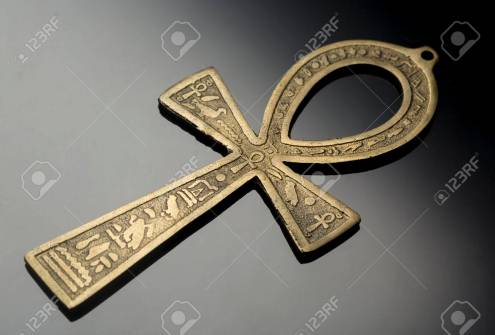
Moreover, Isis is depicted holding an ankh, which is a symbol for life itself. In Wikipedia, it says,
The ankh or key of life is an ancient Egyptian hieroglyphic symbol that was most commonly used in writing and in Egyptian art to represent the word for “life” and, by extension, as a symbol of life itself. The ankh has a cross shape but with an oval loop in place of an upper bar.
Wikipedia
As I also proved in the WPP, Isis, Inanna, Ishtar, and Aphrodite are the same “goddess” under different titles. Ishtar and Aphrodite are often portrayed as very sexual, and this is emphasized in the Sumerian and Babylonian texts, but also in the “Epic of Gilgamesh.” This represents the feminine sexuality, having its origin in Eve, who descended into this very physical and solid construct where we are now residing.
Moreover, it says in the Gnostic texts that Yaldabaoth “raped” Eve, which produced two offspring, Cain and Abel. He probably didn’t sexually rape Eve in a literal sense, but he corrupted the originally pure “bloodline.” In other ancient texts, En.ki raped Isis, which is the same story told from two perspectives.
So, in summary, we could say that Isis represents the journey of the Divine Feminine in Yaldabaoth’s construct. Isis is a representation of us…

